
Ask the Vinschger
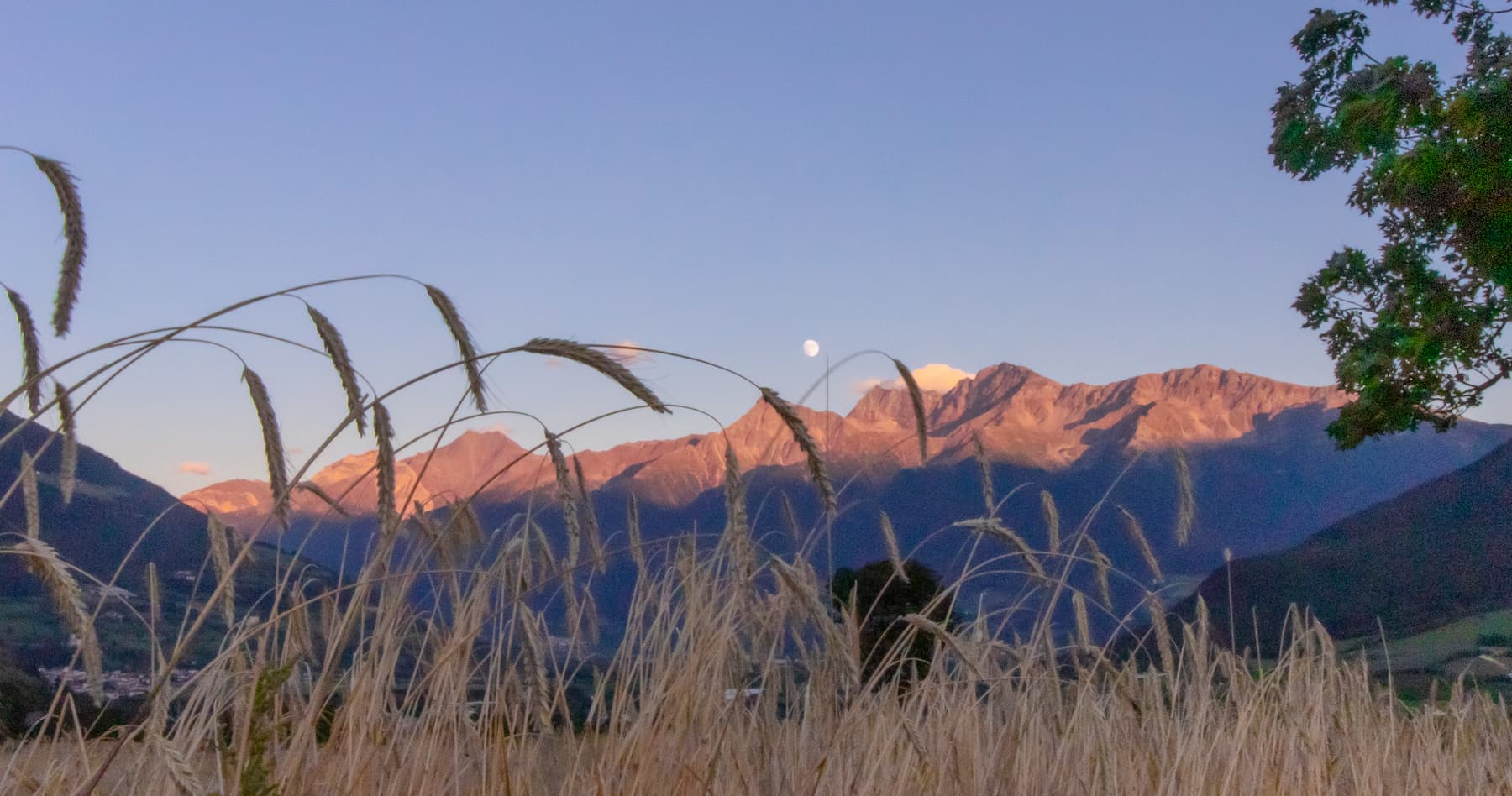
As a host, I spend most of the year here at the FinKa. But in autumn, I like being a guest myself. For the past few years, I’ve been drawn quite reliably north – and usually to Ireland.
I don’t travel particularly fast there. I prefer to settle somewhere for a week and try to understand how the place really works. I go to the pubs, drive around, talk to people and, sooner or later, start asking questions.
And that’s usually where the problem begins.
As soon as you want to learn more about an area online, you keep ending up on the same three or four websites. They tell you what you should see, where to eat and which sights you shouldn’t miss.
What is much harder to find are the other things.
Why a village grew up exactly where it did. Who lived there in the past. What story lies behind an abandoned house. Why certain traditions have survived to this day. What people say about their own region – not just what has been prepared for visitors.
At some point in Ireland, I found myself thinking:
There really ought to be something you could simply ask.
Not:
“What are the top ten sights?”
But:
“Why is it actually like this here?”
That idea became MyLocalScout

Back at the FinKa
Back at the FinKa, I realised that our guests have exactly the same kind of curiosity. Not necessarily in the form of clearly formulated questions. But once you start talking and telling a few stories, many of them suddenly want to know more.
Why there are so many Waale and Waalwege – traditional irrigation channels and the paths that follow them – in the Vinschgau. Why castles seem to stand on every other hill in this valley. Why so many Romanesque churches and frescoes have survived here. Why the villages look the way they do, and why some things work differently here than they do just a few valleys away.
Then one thing leads to another – and suddenly it’s no longer about what you should quickly go and see tomorrow, but about why this region has become the way it is today. I’ve noticed that these connections are exactly what people remember. And in future, at the end of a conversation like that, I can simply say:
If you’d like to know more: Ask the Vinschger
Where the knowledge lives
The problem is that much of what truly explains a region is not found where you would normally look for it.
It can be found in old local records, historical travel accounts, academic studies and written traditions that are now kept in archives and libraries. Some of these texts have barely been read for decades – and yet they often contain exactly the kind of knowledge that helps explain why this valley is the way it is. And then there is a second source that is at least just as important: the people themselves.
In the Vinschgau, there are many people who carry an incredible amount of knowledge in their heads – about farms and families, old paths and field names, work and agriculture, special events, people who are long gone, and things that no one ever wrote down.
So far, we have only captured a small part of this knowledge. In the future, we want to include much more of it: conversations with people from the valley who carry knowledge worth passing on. Not as a folkloristic collection of “things were different in the old days”, but as part of what makes a region what it is – and helps explain it.
Knowledge as a common good
Behind all this is an idea that has become increasingly important to me. The knowledge of a region rarely belongs to one person alone. It lives in people, in places, in historical sources, in archives, in memories and in stories passed from one generation to the next. In the past, there was a good word for something like this: The commons.
The pasture where everyone could graze their cattle. The well everyone drew water from. Something that belonged to no one alone, yet had to be cared for by everyone. Why not apply the same idea to knowledge?
In the long term, MyLocalScout is meant to become a kind of knowledge commons: a shared knowledge landscape of a region where sources, stories, places and voices come together. Not as a database created somewhere from the outside about a region. And not as a random collection of stories. But as something that grows from within the region itself. A common good that no one owns alone and that many people care for together.
That may sound a little grander than a chat window might suggest at first glance. But that is exactly the point: to connect knowledge that has been scattered across many different places and make it accessible again.
What it has become
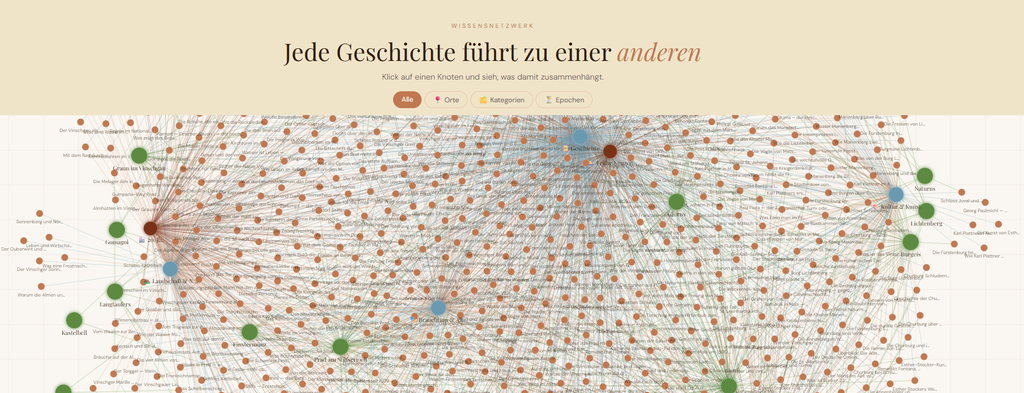
So we began collecting, organising and connecting the dots. Today, more than 1,000 prepared texts from a wide range of sources are available online. The oldest sources date back to 1808. That means the knowledge spans more than two centuries – and it keeps growing. At some point, another question arose: what do you actually do with such a large body of knowledge? A PDF would have been certain death. A brochure probably would have been too. So now you can simply ask it: The Vinschger – local knowledge from the Vinschgau
You type your question just as you would ask a local person, and you receive an answer based on the collected material. In German, Italian or English. It is not only about finding individual facts. It becomes particularly interesting when connections start to emerge: between places and people, landscape and history, old routes, borders, agriculture, religion, trade and the many small events that have shaped a region. And that is exactly what the Vinschger is designed for.
Every answer tells you where it comes from
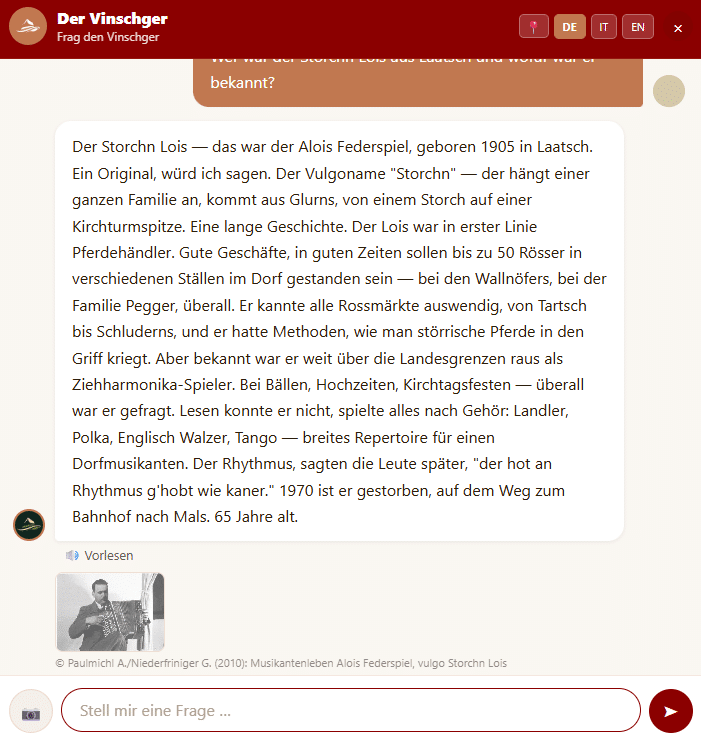
This is the most important part of the whole project for me. The answers are newly formulated from the available material, and connections between different sources are brought together. Under every answer, you can see what it is based on. Anyone who wants to look more closely can browse the publicly available documented sources on the Vinschgau.
It may sound like a small detail. But it is the difference between:
“Someone somewhere claims this about the Vinschgau.”
and:
“There is a documented source for this, and you can check it yourself.”
What the Vinschger cannot do
And now for the part I would rather write down myself than have someone discover it with disappointment. It lives quite strongly in the past. A large part of the material currently deals with history. If you ask what everyday life in the Vinschgau is like today, you will not always get a particularly good answer yet. We want to change that by adding more conversations and contributions from people in the valley. But for now, that is how it is.
It is not a tourist information service. Opening hours, prices, timetables or whether a hiking trail is currently open – that is explicitly not what it is designed for. At least it tells you that instead of simply making something up. For all the practical things, our guests at the FinKa have our information app.
It does not know every part of the valley equally well. At the moment, the focus is still clearly on the Upper Vinschgau. Other parts of the valley are represented less extensively. That is a question of available sources and time, not intention. And it is constantly being expanded.
It can make mistakes. A name can be assigned incorrectly, a date can be mixed up or a connection can be misunderstood. That is exactly why we show the underlying sources. Curated does not mean infallible.
The Vinschger – at a glance
Prepared texts: more than 1,000
Oldest sources: dating back to 1808
Languages: German, Italian and English
Places on the map: 37
Cultural sites: 36
Events on the timeline: 27
Photos: 276
Platform operator: Vinschger Sozialgenossenschaft VISO, Mals
If you know something
A knowledge commons only works if people share what they know. If you have old photographs, know a story that should not be lost, have special knowledge about a place, or know someone we really ought to talk to, we would love to hear from you.
Perhaps you know why a particular farm has its name. How water used to be distributed. Which routes people took before today’s roads existed. Or perhaps you know someone who simply knows these things because they have spent their whole life here. You can contribute local knowledge to MyLocalScout
Or simply write to me.
I’m usually sitting at reception anyway. The Vinschger’s answers are formulated by an AI system using the collected material. The site clearly indicates that AI is being used. But the real work is not in the chat window. It is in the historical traces, in archives and libraries, in old stories – and above all in the minds of the people who live here.
AI simply makes this knowledge searchable through conversation. What really matters comes from the valley.
The best way to try the Vinschger is with a question you have had for a long time but never thought was worth spending hours searching for.
Ask the Vinschgau → And if something is missing or wrong, tell me. That is exactly how it grows.
Frequently asked questions about the Vinschger
What is “The Vinschger”?
It is a freely accessible website where you can ask questions about the history and culture of the Vinschgau. The answers are currently based on more than 1,000 prepared texts from a wide range of sources.
How much does it cost?
Nothing. The site can be used without registration.
Which languages does it support?
German, Italian and English.
Can I use it for opening hours or public transport timetables?
No. That is not what the Vinschger is designed for. It answers questions using historical and local knowledge rather than current timetable, weather or event databases.
Where does the information come from?
From a range of documented historical, local and academic sources, and increasingly from the knowledge of people from the region. The oldest sources used date back to 1808. The source directory is publicly available.
Can I contribute my own knowledge?
Yes. That is intended to become an increasingly important part of MyLocalScout. Anyone with stories, information, old photographs or special knowledge about a place can become a Local Scout or contact us directly.
Who is behind it?
The MyLocalScout platform is operated by Vinschger Sozialgenossenschaft VISO in Mals. The Vinschgau content grew out of the FinKa.
Experience FinKa!
📩 Reservations and room bookings: info@finka.it
📞 Phone: +39 0473 427040
🌐 www.finka.it
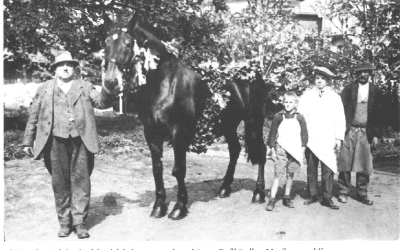
Storchn Lois – a Musician from the Vinschgau
Sometime in the 19th century, a large bird was sitting on top of the church tower in Glurns.Someone asked a man from Laatsch what kind of bird it was. He looked up, thought for a moment — and said: a stork.Whether it really was one, nobody knows to this day. What we...
Cyclists Welcome – FinKa is a Bett+Bike Hostel
Travelling along the Via Claudia Augusta: Why Mals has become the perfect stop between Reschen Pass and Merano for many cyclists.First you hear the quiet click of the gear shift, then a short sigh of relief – finally done. The bicycle is leaned against the wall of the...
Stelvio Pass Road – History, Giro d’Italia & Cycling from Mals
Long before the first cyclist climbs the pass in spring, the road usually still lies hidden beneath metres of snow. Hairpin after hairpin it rises from Gomagoi, climbs past Trafoi towards the Franzenshöhe and then winds its way through the high-alpine landscape up to...
Want to be part of this story?
www.finka.it
