
Storchn Lois – a Musician from the Vinschgau
Sometime in the 19th century, a large bird was sitting on top of the church tower in Glurns.
Someone asked a man from Laatsch what kind of bird it was. He looked up, thought for a moment — and said: a stork.
Whether it really was one, nobody knows to this day. What we do know is that the name stuck. Not to the bird. To the man. And then to his son, his grandsons, his great-grandsons — to the whole family, right down to the present day.
That is how names work around here. One quick glance upwards, one guess, and there you have a family chronicle for five generations. No coat of arms, no noble title. Just a bird that was probably a heron.
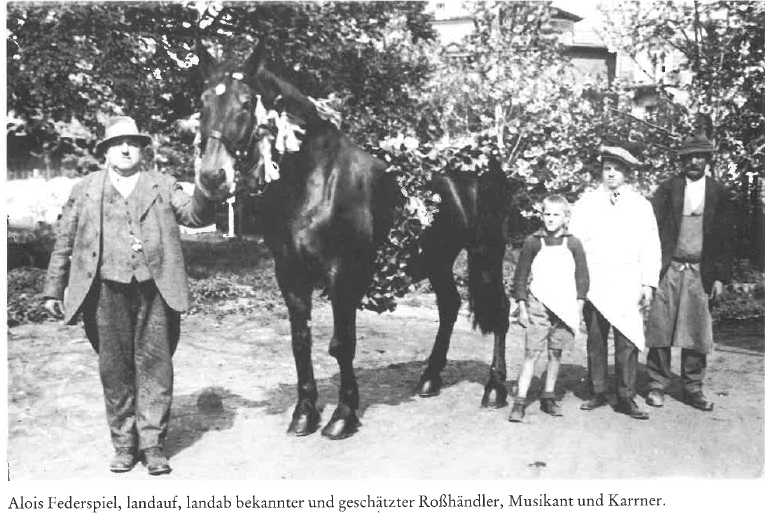
The most famous of these “storks” was born in Laatsch on 2 September 1905. His name was Alois Federspiel.
Everyone called him Storchn Lois.
First, we need to talk about the Karrner
Because Lois was one of them. Karrner — for a long time, the word was used as an insult in the valley. It referred to people who loaded everything they owned onto a cart and travelled from village to village: knife grinders, tinkers, broom makers, travelling traders. They were often disparagingly called “Gypsies”, but in fact they were impoverished locals. Neighbours. People whose fields had been divided again and again through inheritance until there was no longer enough left for a family to live on.
Around 1835, there were 53 Karrner in Stilfs, 30 in Laatsch, 21 in Planail and 20 in Prad. In Laatsch, one in every seven families was a Karrner family in 1836. The district court in Glurns listed 188 cart travellers by name. This was not some marginal group. It was a substantial part of the village population.
They traded in whetstones and tow — the coarse fibres left over from hemp processing — as well as anything else that could be sold. At markets in northern Italy, they bought lemons and oranges and sold them north of the Alps, where such fruit was still a rarity.
A children’s rhyme from Prad has survived:
Touini, Limouni, Orantschagugu — a Pfeifl voll Tawagg isch meahr weart ass du.
You don’t need to translate it to hear that someone is being made fun of here.
The authorities did not find any of this amusing. There were bans on marriage. Passports were refused. Anyone who wanted to marry without owning a house or property could end up in the “Loch” in Glurns — literally the local jail, and I think that name needs no improving. And many people in the Vinschgau still know the saying “to argue like the Karrner”. What lies behind it, however, only a few still know.
Horse or cattle? Even my own database can’t agree
Did Storchn Lois trade in cattle or in horses? I honestly can’t say for certain.
I discovered this while researching the article and then spent a while staring at the screen. He was probably both, as he was many things. If you travelled as a Karrner, you did not specialise. You traded in whatever the market offered, and the horse-market calendar determined where you would be in spring.
But I like the fact that a man who spent his whole life on the move and never quite allowed the authorities to put him into a neat category still manages, a hundred years later, to confuse my database as well.
He never had sheet music, and he never needed it
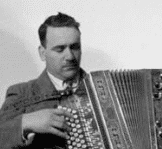
Storchn Lois was a musician. He played the accordion. And not just in the way half the valley played the accordion, but so well that experts count him among the finest players of his time. He never had sheet music. He never needed it.
And here comes the twist that life itself came up with: these very pieces, played by a man who never had a single note in front of him, were painstakingly listened to and written down by a musician a hundred years later — in standard notation and in button notation, so that students could learn to play them.
The result was two booklets, published in 2010 by Andreas Paulmichl and Gernot Niederfriniger. For the booklets, parish archives were researched, eyewitnesses were interviewed and the surviving pieces were transcribed into musical notation. The project was supported by the Department of Folk Music, the Austrian Folk Song Society and the South Tyrolean Folk Music Association.
A Karrner from Laatsch, a man who was not even considered worthy of a passport, is now part of the teaching repertoire.
How the stork became a feather
In 1935, forced Italianisation reached family names as well. Federspiel officially became Lapenna.
The feather.
Just imagine it for a moment: someone sits in an office and translates a Vinschgau family name into Italian, syllable by syllable, and somehow ends up with “the feather” — for a family whose nickname comes from a bird that probably no one ever identified correctly in the first place.
Without even realising it, bureaucracy had produced perhaps the only vaguely poetic official act in its history. Unsurprisingly, the name never caught on. In the village, he remained Storchn Lois.
Traditional bynames are more stubborn than official decrees, and that is one of the most reliable rules in this valley.
What remains
Storchn Lois died a little over half a century ago. His melodies remain.
Actually, that may be the most beautiful twist in the whole story. Music in the Vinschgau was never something that belonged only in concert halls. It was played in parlours, in inns, at weddings, at festivals and wherever a few people happened to gather. One person played a tune, the next listened and later played it on:
Without an archive.
Without a recording device.
And often without sheet music, too.
That is how melodies could survive for an astonishingly long time. And this kind of music has not disappeared entirely even today. People still play music in the Vinschgau: in inns and at festivals, on small stages and sometimes simply around a table where, by chance, the right people happen to be sitting.
That is exactly the idea we want to build on with the FinKa Festival
Not by trying to recreate the time of Storchn Lois. And not by putting folk music in a museum. Quite the opposite. Music only stays alive when it is played, when it changes, when it encounters other music and is passed on by people. That is why musicians from the valley and from far beyond come together at the FinKa Festival. In 2026, some of them will come from Ireland — a country where the old pub and session culture is still very much alive today.
Perhaps, then, the distance between a Laatsch accordion player a hundred years ago and an Irish session at the FinKa is not so great after all.
Someone sits down and starts to play.
Another listens.
And eventually joins in.
That is how music stays alive.
Storchn Lois would surely have joined in.
Experience FinKa!
Ask the Vinschger
As a host, I spend most of the year here at the FinKa. But in autumn, I like being a guest myself. For the past few years, I’ve been drawn quite reliably north – and usually to Ireland.I don’t travel particularly fast there. I prefer to settle somewhere for a week and...
Cyclists Welcome – FinKa is a Bett+Bike Hostel
Travelling along the Via Claudia Augusta: Why Mals has become the perfect stop between Reschen Pass and Merano for many cyclists.First you hear the quiet click of the gear shift, then a short sigh of relief – finally done. The bicycle is leaned against the wall of the...
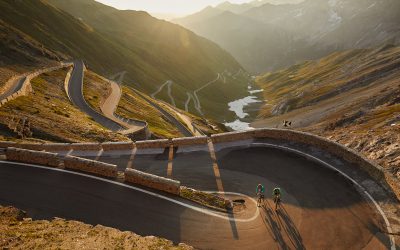
Stelvio Pass Road – History, Giro d’Italia & Cycling from Mals
Long before the first cyclist climbs the pass in spring, the road usually still lies hidden beneath metres of snow. Hairpin after hairpin it rises from Gomagoi, climbs past Trafoi towards the Franzenshöhe and then winds its way through the high-alpine landscape up to...
Want to be part of this story?
www.finka.it
